
How Song Thủ Đề Differs From Other Number Formats
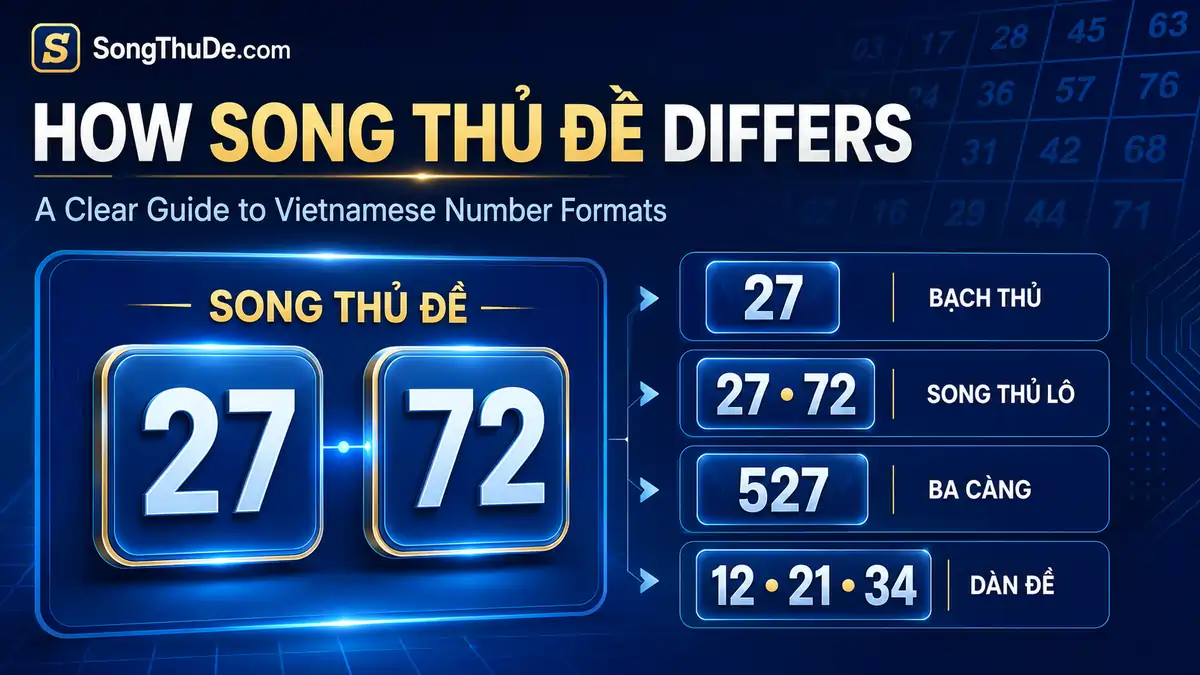
Song Thủ Đề is a Vietnamese number-selection term commonly used for a pair of two-digit numbers. It is frequently confused with bạch thủ đề, song thủ lô, lô xiên, dàn đề, and ba càng because these formats may use similar digits but follow different comparison rules.
The main differences involve:
- How many numbers are selected
- How many digits each selection contains
- Which part of the published result is checked
- Whether one or every selected number must match
- Whether the term refers to an official lottery ticket or an informal number format
This guide explains the terminology for educational purposes. It does not provide predictions, recommended numbers, betting instructions, or guaranteed outcomes.
Song Thủ Đề at a Glance
| Feature | Song Thủ Đề |
|---|---|
| Number of selections | Two |
| Digits per selection | Two digits |
| Example format | 27 and 72 |
| Common result reference | Last two digits of the special prize |
| Required match | One selected number matches the applicable result |
| Prediction guarantee | None |
| Official lottery ticket | No, the term itself does not describe a standard ticket |
In simple terms, Song Thủ Đề means identifying two separate two-digit numbers under the "đề" format.
For example:
- First number: 27
- Second number: 72
These are two distinct selections. They are sometimes arranged as reversed pairs, but reversal is not required for every Song Thủ Đề combination.
What Does "Song Thủ" Mean?
The phrase can be separated into two parts:
- Song – two or a pair
- Thủ – a selected or closely followed number
- Đề – a format commonly associated with the final two digits of a special-prize result
Therefore, Song Thủ Đề generally refers to two selected numbers checked under the đề convention.
The word "song" describes the quantity of selections. It does not mean that both numbers must appear together.
This is an important distinction because some combined formats, such as lô xiên 2, normally require every selected number to satisfy the applicable condition.
Song Thủ Đề vs Bạch Thủ Đề
Bạch thủ đề uses one two-digit selection, while Song Thủ Đề uses two.
| Feature | Bạch Thủ Đề | Song Thủ Đề |
|---|---|---|
| Number of selections | One | Two |
| Digits per selection | Two | Two |
| Example | 27 | 27 and 72 |
| Common comparison point | Last two digits of the special prize | Last two digits of the special prize |
| Main difference | One selected number | Two selected numbers |
Example:
- Bạch thủ đề: 27
- Song Thủ Đề: 27 and 72
Both formats may refer to the same result position. However, the number of selections is different.
Adding another number does not improve the predictability of the draw. It simply changes the number of possible matches and may increase total financial exposure where money is involved.
Song Thủ Đề vs Song Thủ Lô
Song Thủ Đề and song thủ lô both involve two two-digit numbers. However, they are normally checked against different parts of the result table.
| Feature | Song Thủ Đề | Song Thủ Lô |
|---|---|---|
| Number of selections | Two | Two |
| Number length | Two digits | Two digits |
| Common result reference | Last two digits of the special prize | Last two digits across eligible prize results |
| Possible repeated appearance | Normally based on one designated result | A number may appear more than once |
| Same format? | No | |
Example selections:
- 18
- 81
Under the Song Thủ Đề format, the pair is commonly associated with the final two digits of the designated special-prize result.
Under the song thủ lô format, the same numbers may be checked against the final two digits appearing throughout multiple eligible prize results.
The selected digits may look identical, but the result scope is different. A number appearing in another prize does not necessarily satisfy a đề-based comparison.
Song Thủ Đề vs Lô Xiên 2
These formats both involve two numbers, but their matching conditions are different.
Lô xiên 2 generally combines two lô selections and requires both to appear under the applicable result rules.
| Feature | Song Thủ Đề | Lô Xiên 2 |
|---|---|---|
| Number of selections | Two | Two |
| Result category | Đề | Lô |
| Common requirement | One of the two matches the designated đề result | Both numbers must satisfy the lô condition |
| Comparison scope | Designated special-prize ending | Eligible endings across multiple prizes |
Example:
- Selected numbers: 24 and 68
- Only 24 appears among eligible lô results
Under a standard song thủ lô interpretation, 24 may count as a matching selection. Under lô xiên 2, the combination would not be complete because 68 did not also appear.
Song Thủ Đề should not be called "xiên đề" merely because two numbers are listed together.
Song Thủ Đề vs Dàn Đề
A dàn đề contains a larger group of two-digit selections.
| Format | Typical Number of Selections |
|---|---|
| Bạch thủ đề | One |
| Song Thủ Đề | Two |
| Dàn đề | Several |
Example of a simple dàn:
- 12
- 21
- 34
- 43
- 56
- 65
The exact number of selections in a dàn can vary. Terms such as dàn 5 số, dàn 10 số, or dàn 20 số may describe the number of two-digit entries included.
Song Thủ Đề is therefore much narrower: it contains exactly two selected numbers.
A larger dàn covers more possible combinations but also creates greater exposure when every entry involves a separate stake. It cannot make a random result predictable.
Song Thủ Đề vs Ba Càng
Ba càng uses a three-digit number rather than a two-digit number.
| Feature | Song Thủ Đề | Ba Càng |
|---|---|---|
| Digits per selection | Two | Three |
| Typical example | 27 and 72 | 527 |
| Number of Song Thủ selections | Two | Not applicable |
| Common comparison | Two-digit ending | Three-digit ending |
For example:
- Song Thủ Đề: 27 and 72
- Ba càng: 527
The number 527 contains 27 as its final two digits, but 527 and 27 are not the same number format. One uses three digits, while the other uses two.
Song Thủ Đề vs Đầu and Đuôi
The terms đầu and đuôi classify individual digits within a two-digit number.
For the number 47:
- Đầu: 4
- Đuôi: 7
A đầu or đuôi group may contain several complete two-digit numbers.
Example of numbers with đầu 4:
- 40
- 41
- 42
- 43
- 44
- 45
- 46
- 47
- 48
- 49
Song Thủ Đề identifies two complete two-digit selections. It is not limited to one leading or ending digit unless the chosen pair happens to share that characteristic.
Song Thủ Đề vs Chạm
A chạm groups numbers containing a particular digit in either position.
For example, chạm 5 can include:
- 05
- 15
- 25
- 35
- 45
- 50
- 51
- 52
- 53
- 54
Song Thủ Đề contains only two selected numbers. A chạm-based group can contain many numbers connected by one shared digit.
Therefore:
- Song Thủ Đề describes the number of selections.
- Chạm describes a shared digit pattern.
Song Thủ Đề vs Tổng
Tổng refers to the sum of the two digits, usually interpreted by its final digit.
Example:
For 27:
Therefore, 27 belongs to tổng 9.
For 72:
The reversed pair also belongs to tổng 9.
However, a tổng group can include several different numbers. Song Thủ Đề remains a pair of specifically identified two-digit selections.
Song Thủ Đề vs Kép
A kép is a two-digit number containing repeated digits.
Examples include:
- 00
- 11
- 22
- 33
- 44
- 55
- 66
- 77
- 88
- 99
Song Thủ Đề can include kép numbers, but it does not have to.
Examples:
- 22 and 77 – a Song Thủ Đề pair containing two kép numbers
- 23 and 32 – a Song Thủ Đề pair containing no kép number
"Kép" describes the internal digit pattern. "Song thủ" describes the number of selections.
Song Thủ Đề vs Số Lộn
A số lộn is formed by reversing the order of two different digits.
Examples include:
- 12 and 21
- 36 and 63
- 47 and 74
Many Song Thủ Đề pairs are presented as reversed numbers. However, not every pair has to follow this pattern.
For example:
- 24 and 42 – reversed pair
- 24 and 67 – two unrelated numbers
Both may be described as two selections. The first is also a lộn pair, while the second is not.
Numbers with repeated digits, such as 44, remain the same when reversed.
Song Thủ Đề vs Even–Odd Formats
Two-digit numbers can also be classified according to whether their digits are even or odd.
| Pattern | Meaning | Examples |
|---|---|---|
| Even–even | Both digits are even | 24, 68 |
| Odd–odd | Both digits are odd | 13, 75 |
| Even–odd | First digit even, second digit odd | 27, 45 |
| Odd–even | First digit odd, second digit even | 14, 72 |
Song Thủ Đề does not require a specific even–odd pattern. The pair can contain numbers from the same or different classifications.
These labels describe number structure only. They do not demonstrate that a number is more likely to appear.
Song Thủ Đề vs Traditional Lottery Tickets
A traditional Vietnamese lottery ticket contains a printed number and is subject to the official prize structure established for that ticket.
Song Thủ Đề is a number-format term. It should not automatically be treated as the name of an official lottery product.
| Feature | Song Thủ Đề Term | Traditional Lottery Ticket |
|---|---|---|
| Basic form | Two selected two-digit numbers | Printed ticket number |
| Official physical ticket | Not necessarily | Yes |
| Prize eligibility | Depends on the format or service involved | Determined by official ticket rules |
| Verification | Applicable published result and rules | Official ticket and published draw |
| Claim procedure | Depends on the provider | Official lottery claim process |
A person should not assume that matching two ending digits under an informal number convention produces the same prize as holding an official winning ticket.
Song Thủ Đề vs Vietlott Number Selections
Vietlott games use product-specific rules and number matrices. A player may need to select several numbers from a defined range, depending on the game.
Song Thủ Đề normally uses:
- Two selections
- Two digits per selection
- Numbers ranging from 00 to 99
A Vietlott ticket may instead contain:
- Several selected numbers
- A specified number range
- A draw structure defined by the individual product
- Official ticket validation and prize categories
The formats should not be treated as interchangeable merely because both involve choosing numbers.
Quick Comparison of Vietnamese Number Formats
| Format | Selection Structure | Common Result Reference | Key Requirement |
|---|---|---|---|
| Bạch thủ đề | One two-digit number | Special-prize ending | Selected number matches |
| Song Thủ Đề | Two two-digit numbers | Special-prize ending | One selected number matches |
| Song thủ lô | Two two-digit numbers | Eligible endings across prizes | One selected number appears |
| Lô xiên 2 | Two two-digit numbers | Eligible endings across prizes | Both selected numbers appear |
| Dàn đề | Several two-digit numbers | Special-prize ending | One number in the group matches |
| Ba càng | One or more three-digit numbers | Applicable three-digit ending | Three digits match |
| Chạm | Group sharing one digit | Depends on format | Selected result contains the digit |
| Kép | Repeated-digit number | Depends on format | Both digits are identical |
| Số lộn | Reversed two-digit pair | Depends on format | Digits appear in opposite order |
Exact terminology and settlement conditions can vary between sources or services. Their published rules should always be checked rather than inferred from the name alone.
Worked Terminology Example
Suppose the published special-prize result ends in 42.
The following interpretations may apply:
- Bạch thủ đề selection 42: the single number matches.
- Song Thủ Đề selections 24 and 42: one of the two numbers matches.
- Song Thủ Đề selections 24 and 67: neither number matches.
- Ba càng selection 142: this requires a three-digit comparison, not merely the ending 42.
- Chạm 4: the result contains the digit 4.
- Tổng 6: 4 + 2 = 6.
- Lộn pair: 42 is the reversed form of 24.
This example demonstrates how one result can belong to several descriptive groups while each term retains a different meaning.
Common Misunderstandings
Assuming Song Thủ Đề and Song Thủ Lô Are Identical
Both formats use two numbers, but the result positions used for comparison are different.
Believing Both Song Thủ Đề Numbers Must Match
The pair represents two alternative selections. A single two-digit special-prize ending cannot normally equal two different numbers simultaneously.
Treating Every Pair as Reversed Numbers
Reversed pairs are common, but Song Thủ Đề can also contain unrelated two-digit numbers.
Confusing a Two-Digit Ending With the Complete Result
A full published result may contain five or six digits. Song Thủ Đề commonly refers only to the applicable final two digits.
Assuming More Selections Guarantee Success
Selecting two numbers instead of one changes coverage and possible cost. It does not create a reliable prediction or guaranteed return.
Treating Informal Number Formats as Official Tickets
An official lottery ticket has its own number, price, prize structure, validation rules, and claim procedure. Informal number terminology does not replace those requirements.
How to Read Number-Format Content Carefully
Before interpreting any number-related article, readers should identify:
- The number of selections
- The number of digits in each selection
- The regional result being discussed
- The exact prize position used for comparison
- Whether every selection or only one must match
- Whether repeated appearances matter
- Whether the content refers to an official lottery product
- Whether the result comes from an official source
- Whether the published information is educational or promotional
A number should never be assumed to be a prediction simply because it appears in a statistics table or historical-result guide.
Historical Results Do Not Predict the Next Draw
Past results can be organized by:
- Date
- Region
- Draw
- Prize
- Number ending
- Frequency
- Even or odd structure
- Reversed pairs
- Repeated digits
- Digit sums
These records describe what already happened. They cannot establish which number will appear in the next random draw.
A number that has appeared frequently is not guaranteed to repeat. Likewise, a number that has not appeared recently is not "due" to occur.
Responsible Use of Number Information
Number-format guides should be used to understand terminology and read published results more accurately.
Eligible adults who choose to participate in legal lottery or Sports Betting activities should:
- Follow applicable age and legal requirements
- Use authorized services only
- Verify results through official sources
- Treat participation as entertainment
- Use only disposable money
- Set spending and time limits beforehand
- Avoid borrowed or essential funds
- Never chase losses
- Ignore guaranteed-result claims
- Take regular breaks
- Seek support when participation becomes difficult to control
No number format, historical pattern, statistical table, or selection method can guarantee a successful outcome.
Frequently Asked Questions
Song Thủ Đề commonly refers to two selected two-digit numbers compared with the applicable final two digits of a special-prize result.
Bạch thủ đề contains one two-digit selection. Song Thủ Đề contains two separate two-digit selections.
No. Song Thủ Đề is commonly associated with the designated special-prize ending, while song thủ lô checks eligible two-digit endings across multiple prize results.
Normally, the two numbers serve as alternative selections. However, readers should always check the exact published rules of the format being discussed.
No. Pairs such as 27 and 72 are common, but two unrelated numbers can also form a two-selection format.
Related Guides
Readers may continue with:
- What Is Song Thủ Đề?
- Vietnamese Lottery Terminology
- Bạch Thủ Đề Explained
- Song Thủ Lô Explained
- Lô Xiên Number Formats
- How to Read Vietnamese Lottery Results
- How to Verify Lottery Results
- Lottery Guides
- Sports Betting Guides
- Responsible Gaming
- Frequently Asked Questions
Final Explanation
Song Thủ Đề is best understood as a pair of two-digit selections commonly associated with one designated special-prize ending.
It differs from bạch thủ đề, which uses one selection; song thủ lô, which checks a broader group of prize endings; lô xiên 2, which generally requires both selected numbers; dàn đề, which contains several selections; ba càng, which uses three digits; and chạm, tổng, kép, and số lộn, which describe number patterns.
Understanding these distinctions can prevent readers from confusing the selected numbers, result positions, and matching conditions.
SongThuDe.com provides independent educational information about Vietnamese lottery terminology, historical results, number formats, and Sports Betting categories. It does not sell lottery tickets, accept wagers, operate a sportsbook, provide guaranteed predictions, or promise successful outcomes. Readers should follow applicable laws and participate responsibly.